What is Hair Tissue Mineral Analysis test?
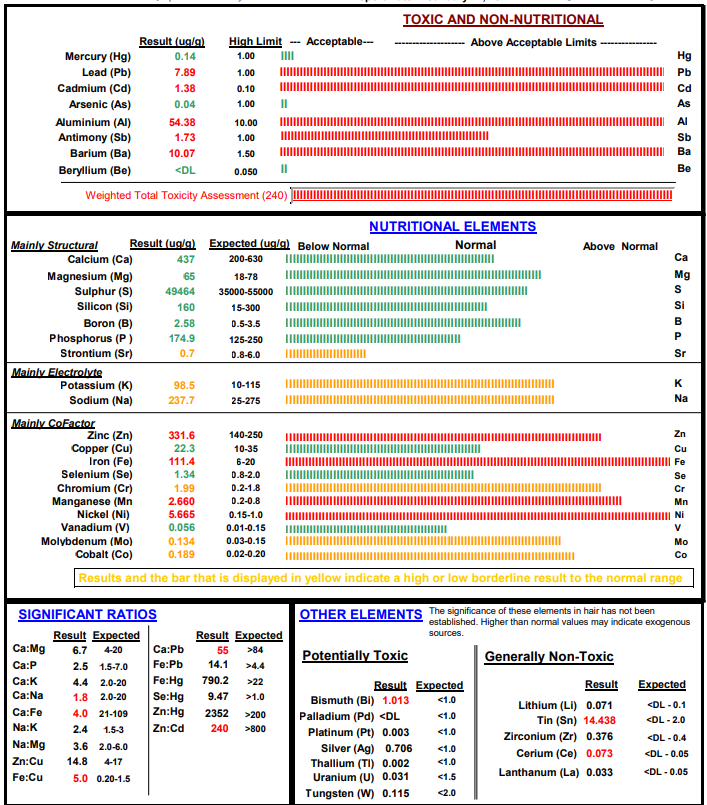
Hair Tissue Mineral Analysis is the measuring or testing of the mineral secretion levels and ratios excreted via the hair over a period of three months preceding the test.
Therefore, HTMA offers a measurable window into how the body is performing in eliminating and/or accumulating the “good” and the “not so good” minerals for that period.
A Hair Tissue Mineral Analysis test is an essential step towards reclaiming your True Health and Vitality because minerals are considered the body's spark plugs. Minerals help enzymes break down and produce building blocks of physical reality, including our body and plants.
This is fundamental for the development of a Personalized Nutritional Plan.
Your health practitioner should have the depth of knowledge to understand the Hair Tissue Mineral Analysis results and determine what could possibly be happening in your body in relation to minerals: their absorption vs malabsorption, their interactions with each other, their effects on your organs and overall health, and how those effects will manifest in your body-your presenting symptoms.
However, Hair Tissue Mineral Analysis test does not diagnose the conditions/diseases/illnesses you may be suffering from; it simply reports on the toxicity levels, over secretions or deficiencies affecting your body.
Hair Tissue Mineral Analysis (HTMA) test provides tremendous amount of information about the body’s chemical state, and not about any diseases, which often are given names for symptoms. For example:
a) Hair Tissue Mineral Analysis results indicate a high level of inflammation markers. This inflammation can manifest in conditions such as arthritis, gastritis, iritis, and many others.
b) Hair Tissue Mineral Analysis results indicate high calcium levels which can settle down in soft tissues resulting in calcium deposits, which, can then manifest as conditions such as arteriosclerosis, arthritis, spondylitis, bursitis, gallstones, kidney stones, and many more.

What can be done with the results of your Hair Tissue Mineral Analysis (HTMA)?
a) HTMA May indicate the need to make lifestyle changes to bring your body into balance or homeostasis.
These challenges could be adrenal overexertion, unhappy relationships, unhealthy environments, disbalance from medications, recreational drugs, and cosmetics.
b) HTMA can also detect dietary problems such as too much aluminum from large fish, too many proteins, excessive carbohydrate intake, overconsumption of soda or carbonated drinks, and more.
c) HTMA can help determine your Metabolic Body Type: this can assist your clinician understand many of your symptoms and guide him/her to recommend the correct mineral supplement programme within your Personalized Nutritional Plan.
d) HTMA can help determine the duration of treatment, and the proper/correct dosage of supplementation required for your full recovery as per your Personalized Nutritional Plan.
e) HTMA can help reveal your glandular and organ state of health by showing thyroid levels, the adrenal hormones levels, and cellular functions. It can also provide an indication of the health of the liver, kidneys, and stomach acid levels.
f) HTMA offers a window to the triggers of depression, anxiety, panic attacks, attention-deficit disorders, brain fog, and even schizophrenia. The results of the Hair Tissue Mineral Analysis test can show how minerals can affect the course of treatment of these conditions. It can also reveal if you had trauma and how your body has learned to adapt to it. The Personalized Treatment Plan developed by your clinician and you will focus on what is most important to you.
g) And so much more… give us a call 416-909-7271
How is a Hair Tissue Mineral Analysis test performed?
It is performed by CanAlt Laboratories.
A Hair Tissue Mineral Analysis test is done by obtaining a tablespoon (15 grams) of your hair, preferably from the head or facial hair, and from as close to the root as possible.
The test analyzes approximately 60 minerals with an accuracy of within about 3%, the same as a blood test and other tissue analysis standards.